Fall of Adam and Eve
Paradise LostThe Fall of Adam and Eve is the central reversal by which the inhabitants of the Garden of Eden pass from innocence into guilt, mortality, and divided consciousness. It begins with the Serpent’s fraud at the Tree of Knowledge of Good and Evil and reaches its decisive human act when Eve eats the forbidden fruit and Adam follows, not because he has been deceived in the same way, but because his love for Eve overcomes his better knowledge. The scene joins temptation, intellectual self-assertion, erotic desire, and self-sacrificing attachment into one catastrophic action.
Causes and Background
The immediate cause is the Serpent’s approach to Eve at the Tree of prohibition. Having tasted the fruit, the Serpent presents itself as transformed: it claims to have acquired reason, speech, and the power to contemplate the visible universe. Its display of enlarged understanding makes the forbidden tree appear not as a boundary but as the source of a higher nature. The Serpent then leads Eve through Paradise by a winding route that makes “intricate seem strait,” a deceptive movement whose apparent brightness resembles a wandering fire that misleads a night traveler toward bogs and pools. The image gives the temptation a material and spatial form: the guide does not merely argue; it conducts Eve bodily toward the source of ruin.
Eve initially knows the command clearly. She states that she and Adam may eat from every other tree, but that God has forbidden the fruit of this particular tree and has attached death to eating it. Her innocence does not mean ignorance of the rule. Rather, the temptation begins by making obedience appear intellectually deficient. The Serpent asks whether God has really prohibited all the trees, then challenges the justice of withholding knowledge from beings appointed as lords of Earth and air. Its argument converts a command into a supposed injury and presents disobedience as courage in defense of human dignity.
Eve’s Transgression
At noon, appetite and the savory smell of the fruit intensify Eve’s attraction. She reasons that the tree must possess extraordinary virtue because the Serpent’s first taste has given it speech and understanding. The name Tree of Knowledge of Good and Evil seems, to her, to disclose the goodness being withheld. The prohibition therefore increases the fruit’s desirability: what is forbidden appears to confirm the value of what it conceals. Eve also questions why death should apply to her when the Serpent has eaten and continued to live, speak, reason, and discern.
Her internal argument turns freedom into a license to reject the command. She asks whether knowledge of good and evil can be denied to human beings while being available to a beast, and whether death was invented for them alone. The fruit appears to promise simultaneous nourishment of body and mind. In this moment, the fall is not represented as a thoughtless appetite alone. Eve interprets the command, compares examples, weighs consequences, and mistakes the Serpent’s apparent survival for proof that the threat is false. Her reasoning is active but corrupted by a desire that has already selected its conclusion.
She then reaches out, plucks the fruit, and eats. The act is immediately enlarged beyond a private gesture: Earth feels the wound, and Nature sighs through all her works as signs of universal woe announce that all is lost. The Serpent withdraws into the thicket, while Eve remains absorbed in the pleasure of eating. Her expectation of knowledge heightens the sensation, so that she cannot distinguish fully between an actual transformation and the intoxicating force of anticipation. Sated and exhilarated, she praises the tree as a source of wisdom and imagines tending it each morning, easing the burden of its full branches and spreading its benefits to others.
Adam’s Choice
Eve’s first concern after eating is not simply whether she has changed, but how to appear before Adam. She considers whether to reveal her new condition and share its supposed happiness, or to keep superior knowledge as a means of becoming more equal, and perhaps even superior, within their relationship. The possibility of losing Adam finally determines her. If death follows, she imagines Adam living with another Eve while she is extinct; therefore she resolves that he will share either bliss or woe with her. Her decision shows that love is both her motive for disclosure and the means by which the transgression spreads.
Adam has been waiting for her return and has woven a garland of flowers to adorn her hair and crown her labor. Yet his heart already misgives him, and he goes toward the route she took that morning. Near the Tree of Knowledge of Good and Evil, he meets her carrying a freshly gathered branch whose fruit appears beautiful and whose smell is ambrosial. Eve approaches with an apology already forming in her expression, then tells him that the tree is not dangerous but divine in effect. She recounts the Serpent’s transformation and claims that the fruit has opened her eyes, enlarged her spirit, expanded her heart, and raised her toward Godhead, chiefly because she sought that state for him.
Adam’s reaction is immediate horror. The garland falls from his slack hand, its roses scattered, while he stands pale and speechless at the knowledge of Eve’s fatal trespass. He recognizes that she has been deceived by an enemy, but he also declares that he is ruined with her. His reasoning attempts to minimize the danger: the Serpent lives after eating, and perhaps God will not destroy the prime creatures set over all created works. Yet beneath these arguments lies the decisive motive. Adam fixes his lot with Eve and chooses to undergo the same doom. He understands that the command has been violated, but accepts the transgression because separation from Eve appears to him worse than death.
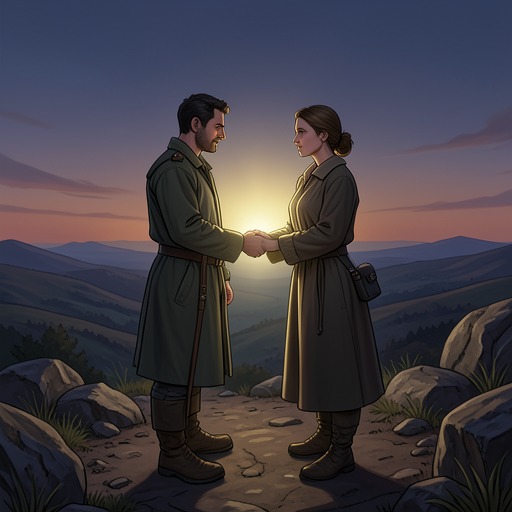
Eve receives his decision as an exalted proof of love. She describes their union as one heart and one soul, and interprets Adam’s willingness to incur divine displeasure as a trial that has revealed the strength of their bond. She even suggests that, if death truly threatened, she would have borne the worst alone rather than draw him into an act destructive to his peace. But she claims that her experience has shown not death but augmented life, opened eyes, new hopes, and new joys. Embracing Adam and weeping for happiness, she gives him the fruit. Adam eats “against his better knowledge,” not deceived like Eve, but overcome by the attraction of love and by the desire not to be divided from her.
Immediate Consequences
The second eating confirms the cosmic seriousness of the act. Earth trembles from its entrails, Nature groans again, the sky darkens, and thunder mutters while sad drops fall at the completion of original sin. The natural world registers the action as a wound, making the Fall simultaneously bodily, environmental, and theological. Adam and Eve, however, initially interpret their condition in the opposite way. Intoxicated as with new wine, they imagine divinity growing within them and fancy themselves equipped to scorn the Earth.
The fruit’s actual operation quickly disproves that fantasy. Instead of granting the stable wisdom they expected, it first inflames carnal desire. Adam and Eve look upon each other with newly awakened lust and retreat to a shaded bank roofed with greenery, where flowers form their couch. Their sexual play becomes both pleasure and the seal of their mutual guilt, a bodily enactment of the act they have committed together. The scene’s reversal is sharp: the fruit promised intellectual elevation, but its first visible effect is disordered appetite.
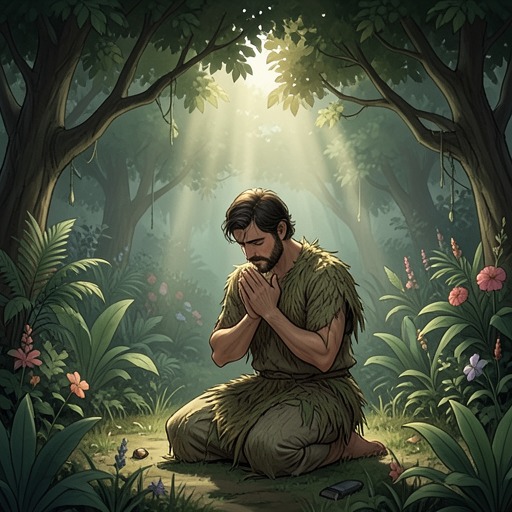
After sleep overtakes them and the fruit’s exhilarating vapor passes, they rise into recognition. Their eyes are open, but their minds are darkened. Innocence, which had previously veiled them from the knowledge of evil, is gone. Thus the Fall produces knowledge in a divided form: perception increases while spiritual clarity diminishes. What seemed like an ascent toward godlike understanding becomes consciousness of guilt, vulnerability, and the loss of the former state.
Meaning and Narrative Significance
The action is structured as a tragedy of misdirected knowledge and divided agency. Eve’s error is an intellectual and moral misreading of prohibition, supported by appetite, pride, and the Serpent’s false evidence. Adam’s error is different: he is not presented as equally deceived, but as choosing solidarity with Eve over obedience to God. Their shared fall therefore arises from two linked but distinct failures—Eve’s confidence in the tempter’s interpretation and Adam’s decision that love requires participation in guilt.
The episode also turns love into a tragic double force. Eve’s affection leads her to share the fruit rather than preserve an unequal advantage; Adam’s affection leads him to accept the same ruin rather than live without her. Their union remains emotionally powerful, but it is no longer innocent. The words and gestures that affirm one flesh now bind them to a common crime, while the promised equality of knowledge is replaced by mutual exposure to desire, shame, and death.
The forbidden fruit is consequently more than a passive object. Its appearance, smell, taste, and promised effects participate in the action, while the tree’s prohibition gives it a power that ordinary abundance cannot possess. Yet the fruit does not simply determine the outcome: the Serpent’s rhetoric, Eve’s interpretation, Adam’s attachment, and the command itself form an interacting chain of causes. The Fall’s enduring significance lies in that chain. A desire to rise above imposed limits leads not to genuine divinity but to the loss of innocence, and an attempt to secure perfect equality through shared experience produces a condition in which both human beings must face guilt and mortality together.